

Tech debt and scope creep
Tech debt and bloated features quietly kill speed. Founders must learn what’s slowing their team down and decide what to fix, rebuild, or cut.
Spot the drag: modules, features, and integrations that eat dev time
The first signal is recurring pain. Your dev team is experiencing drag if it constantly encounters the same issues during sprint retrospectives, unstable integrations, hard-to-read legacy modules, or an “almost done” feature that never ships.
Patterns matter. Check your Git logs, Jira boards, or even team Slack channels. Repeated complaints about brittle tests, long QA cycles, or cryptic error messages often trace back to technical debt hotspots. Developer behavior is a tell, too: if they avoid parts of the codebase or call something “fragile,” that’s a red flag.
Don’t ignore feedback loops from support and QA either. Features that generate high bug reports or confusion often cost more than they’re worth. Tools like Code Climate, Sentry, or even a basic analysis of file churn can provide quantitative signals. But some of your best insights come from asking your team: “What parts of the code would you rewrite if you had a clean slate?”
Learn more about how to use feedback loops to decrease user churn.
How to refactor or kill what’s slowing you down
Once you’ve surfaced the problem areas, the next step is decision-making. Every underperforming module should go through a simple triage: if it’s still delivering value to users, keep it; if it’s rarely used or no longer aligns with your core value proposition, consider sunsetting it; and if it’s valuable but creating friction, weigh the pros and cons of refactoring versus rebuilding.
Use effort vs. impact as your guide. Refactoring works when the architecture is solid and the main issues are messy implementations or tech debt (long functions, duplicated logic, poor tests).
Rebuild when the underlying tech is outdated, the component actively blocks scale, or when migrating (monolith to microservices) is part of your roadmap. Don’t let nostalgia keep legacy features alive if they’re holding your roadmap hostage, it’s time to cut.
Whatever you decide, communicate it. Let stakeholders know why cleaning something up accelerates future development. Technical cleanup should be part of your roadmap, not something you “get to later.”
For a broader perspective, this guide explores the leading causes of SaaS teams’ velocity loss.
Create guardrails to prevent new tech debt from creeping in
Fixing tech debt once is good; preventing it from creeping back in is better. Start with clear coding standards. Linting tools, static analysis, and auto-formatters (like ESLint, Prettier, or SonarQube) reduce inconsistency. Make code reviews mandatory, not just to check syntax but also to flag complexity, test coverage, and maintainability.

Then, integrate debt conversations into sprint planning. When proposing features, include a short “complexity check” by asking key questions: Does this introduce new dependencies? Are we adding state to multiple services? Can it be broken down further?
Finally, track code health like a product metric. Monitor churn, test coverage, PR cycle time, and regression frequency. When quality drops, it’s time for a cleanup sprint, not a Band-Aid fix.
Build guardrails that treat clean code and maintainability as core to your business outcomes. Because if your product velocity depends on the health of your codebase, protecting it isn’t optional.
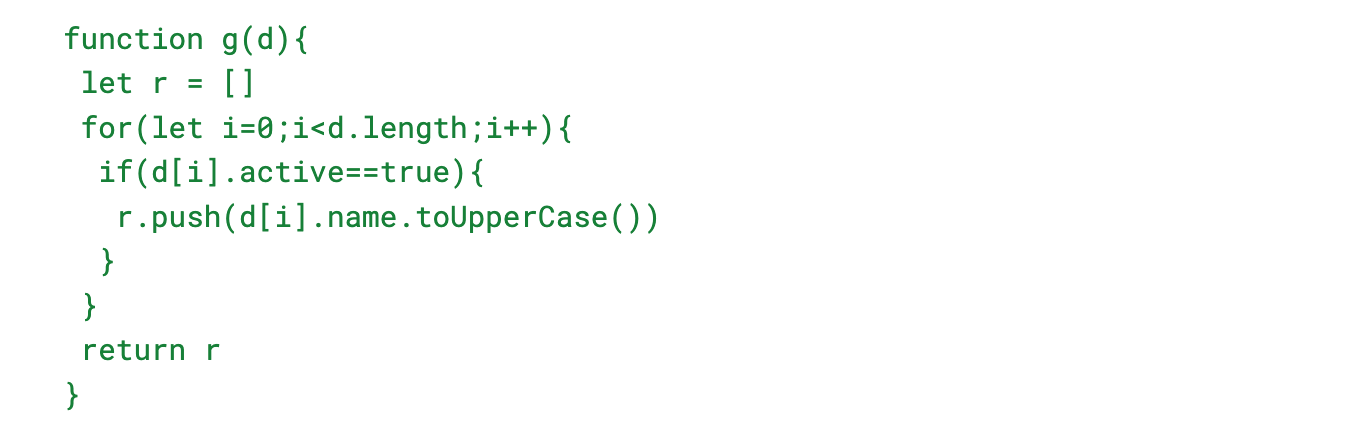
Poorly written JavaScript code example
Source: Designli
What’s wrong:
- Non-descriptive function name (g) and variable names (d, r)
- No comments or documentation
- Inconsistent formatting and spacing
- Logic is embedded in a loop without abstraction
- Weak readability and no error handling
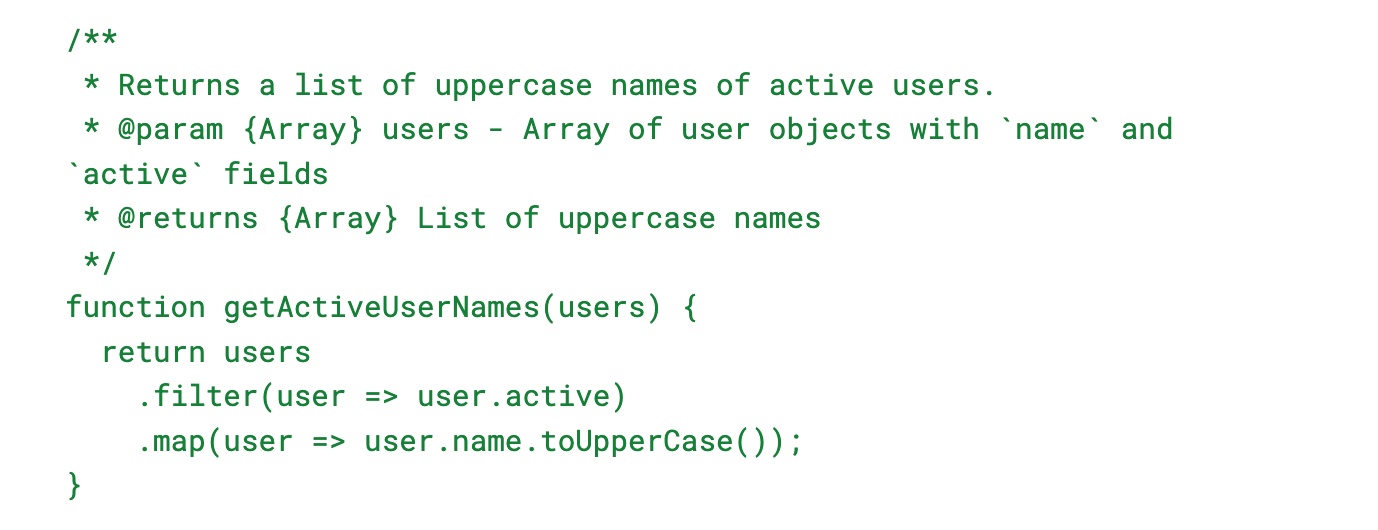
Clean JavaScript code example
Source: Designli
Why it works:
- Descriptive function and variable names: Makes the code self-documenting
- Modular and functional approach: Uses filter and map for clarity
- Scalable and reusable
- Code comment: Explains purpose and input/output
- Consistent formatting: Easier to read and maintain
Feature prioritization
Not every feature deserves to be built. Focus on what drives retention, revenue, or real user value and say no to the rest.
How to tie outcomes to features, customer value, retention, or revenue
In the earliest stages, startups should treat feature development as an ROI exercise. The question isn’t, “Is this feature cool?” but rather, “Will this feature help us acquire, retain, or monetize users?”
Validate every feature request by asking: Who is this for? What problem does it solve? And how does it move metrics like activation, engagement, or expansion?
To find recurring needs, use qualitative signals like support tickets and user interviews, paired with quantitative indicators like drop-off points, feature usage, and retention cohorts. If a feature doesn’t link to one of your core outcomes, it doesn’t belong on the roadmap.
Prioritization frameworks that bring clarity
When everything feels important, nothing truly is. That’s why startups benefit from simple, transparent prioritization models.
- RICE: Score each feature by reach, impact, confidence, and effort; ideal for product teams that need weighted, data-informed rankings.
- MoSCoW: Sort your backlog into must-, should-, could-, and won’t-haves; faster to run, especially in cross-functional groups.
Both frameworks bring objectivity and reduce friction between founders, developers, and stakeholders. They work best consistently in sprint planning, product reviews, and investor updates, which is the path to spending less time debating and more time shipping.
Kill pet projects to keep focus on what matters
It’s tempting when a founder’s “passion feature,” a designer’s experiment, or a stakeholder’s wishlist item slips onto the sprint board.
To stop them before they start, maintain a transparent, ranked backlog where every idea is tracked publicly and tied to a clear business case or metric. Require a lightweight justification for any new roadmap item: what’s the goal, and what happens if you don’t build it? Finally, set up an “experimental track” where new ideas get a time-boxed window to prove their value. If there’s no traction, they don’t move forward.
The key isn’t to kill creativity, it’s to channel it into solving real problems. Make it a cultural norm that every feature must earn its place.
New product development
New ideas should be treated like scoped, time-boxed, and measured bets. Build fast, validate fast, and kill what doesn’t deliver.
Think like an investor when launching new products
The best founders approach new product ideas with skepticism, discipline, and structure, the same way venture capitalists approach startups.
Before writing a single line of code:
- Define the MVP version that solves one core pain point
- Design a structured budget
- Set a success criterion: a goal that, if hit, validates the idea
Examples of MVP success signals:
- 100 signups from a landing page in 2 weeks
- 25% of beta testers use a feature 3x/week
- User willingness to pay above your current pricing
By setting guardrails upfront, you avoid pouring weeks into a dead-end. If the idea gains traction, scale it. If not, kill it and move on.
Split workstreams to keep core and experimental work from competing
Nothing slows a roadmap faster than mixing new ideas into your sprint cycle. Suddenly, your best engineers are context-switching between urgent bugs, roadmap commitments, and “just one quick prototype.”
Instead, isolate experimental work:
- Assign a separate squad, contractor, or part-time pod to run early-stage builds
- Use lighter tools, such as no-code tools or design prototypes, to explore before committing
- Create an “innovation lane” where small bets run in parallel but don’t block the main product team
Keep your core team focused on shipping what matters now, while a small group explores what might matter next.
Install kill switches to pivot, scale, or stop effectively
The biggest danger with new initiatives isn’t failure, it’s lingering half-successes. These are the kind of features that might be useful, so they stick around, eating time without delivering ROI.
That’s why you need pre-defined kill switches. For example: “If we don’t hit 30% engagement by Week 4, we shut it down.” Other triggers might include failing to get two customers to commit after a demo or not validating the idea within six weeks.
When success metrics are vague, decisions can become emotional. Clear kill switches reduce that ambiguity and protect your team’s focus.
Dedicated product teams
Dedicated teams build better, faster. With full focus on your product, they drive alignment, ownership, and long-term momentum.
Full-time focus on one team, product, and goal
Most agency models and freelance setups run on shared resources. A dedicated product team works solely on your product, builds deep domain knowledge, and eliminates wasted time from constant realignment.
That means they develop deep familiarity with your domain, users, and tech stack. They can anticipate issues instead of reacting to them, and every sprint builds on shared context.
This consistency works over time. With less onboarding and realignment, the team moves faster and builds smarter. You’re not just outsourcing tasks, you’re embedding long-term partners who think strategically about your product’s future.
Eliminate context switching and boost developer velocity
Multitasking may look efficient on paper, but it’s a silent killer in development. When developers switch between codebases or clients, they incur a switching cost, the mental overhead of reloading architecture, business logic, and user intent. This context switching can consume up to 40% of a developer’s time.
A dedicated team eliminates that waste. Developers stay immersed in your product, reducing bugs, improving build quality, and spotting optimizations opportunities through deep focus.
For early-stage founders, this focus translates into shorter release cycles, more predictable delivery, and cleaner architecture that’s easier to maintain and scale. You’re not just saving time. You’re multiplying impact.
From coders to collaborators
Great products aren’t built by people who just follow instructions. They’re built by teams who understand the “why” behind every feature.
With full context and long-term investment, developers evolve from executors to collaborators, surfacing edge cases, recommending architectural improvements, and flagging tech debt before it becomes a liability.
This shift in mindset is critical. A dedicated team feels ownership over your product’s success. They care about UX. They speak up in retros. They help product managers and founders make better tradeoffs. And because they’re invested in the long game, they optimize for maintainability and scale, not just getting tickets done.
If you are ready to launch a product effectively through a well-structured process, Designli is ready to help. Schedule your consultation, and let’s get started.