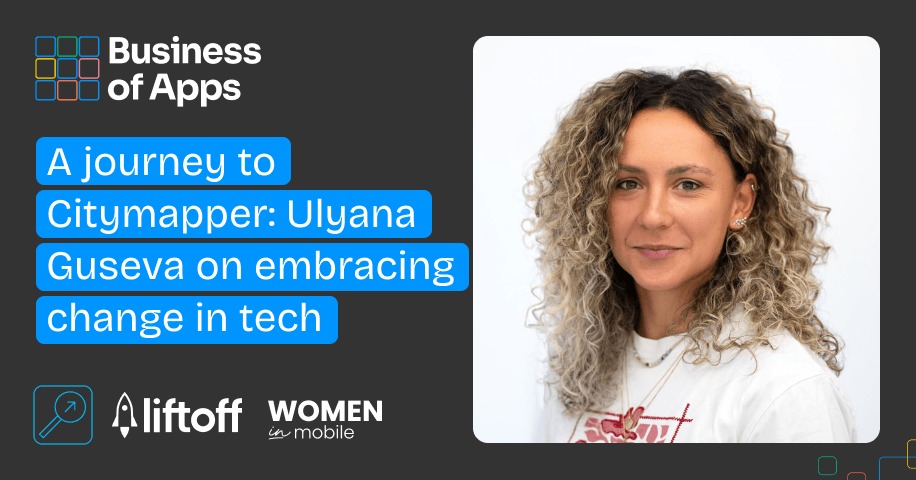
Mobile app advertising, monetization, and insights company Liftoff is bringing together inspirational women from across the mobile industry to share their stories. In this series, we’ll explore their achievements, the challenges they’ve overcome, and their vision for the future — offering insights from the experts shaping the world of mobile apps and technology.
This month’s article focuses on Ulyana Guseva, Head of Advertising Sales at Citymapper.
Can you start by walking us through your career path — how did you get to where you are today?
I actually started my career in hospitality and consulting before I moved into the tech industry, joining Google to work on advertising sales for small and medium-sized businesses in Ukraine, Belarus, and Kazakhstan. That was a very interesting role focused on helping SMBs in those markets grow with the help of Google Ads.
From there, I moved on to Waze (a Google-owned company), which was my first foray into the mobile space. I was still working in advertising sales, but shifted my focus to the UK market and began working with enterprise-level clients. I stayed there for five years in various roles.
Two years ago, I moved to Citymapper, so I have stayed within not just mobile apps, but specifically mobility apps, which has become my area of focus. My current role revolves around growing our advertising revenue across global markets and various channels. This involves overseeing all aspects of the ads business, from product development and go-to-market strategy to sales, covering direct brand and agency partnerships, resellers, and the auction side of the business.
When you were going into your first role in consulting, did you have any idea that your career would move into the tech side of things?
If I’m honest? Not at all! When I was starting out, the tech world just wasn’t the massive, central force it is today. I don’t think we fully realized how big it was going to become.
I actually spoke with some students at an alumni event recently and asked them about their career aspirations. Some of them said, “I don’t know, I’m very open.” I think that’s the best possible approach. Being open to opportunities is crucial because you truly never know how things will change tomorrow. My career moving into tech is a great example of that.
Are there any particular skills that you have found really important as your career has developed? What skills do you feel have helped you progress in your career?
I believe the most important ones are openness to change and eagerness to learn. Things in this industry, especially in tech, evolve so rapidly. Accepting change makes everything easier, not just in terms of finding the next opportunity but also in everyday life, as new things emerge all the time. If you resist rather than adapt & learn, that creates its own problems.
What’s the thing about your job that you most enjoy?
There are lots of things! I really enjoy working with clients and helping them achieve their goals. It sounds cheesy, but because my first job was in hospitality, client service is a big thing for me. Delivering a good service and bringing value to my advertising clients is very important to me. When they’re happy with the results, it makes me happy too.
Another thing I really enjoy, which can be challenging sometimes, is working with different teams across the company. From day one at Citymapper, I’ve been involved in conversations with various teams, which have given me the incredible opportunity to learn how different teams think and what they care about. One common factor, of course, is that the whole Citymapper team cares deeply about the app’s users and strives to do everything possible to make their lives as easy as possible.
Have you encountered any challenges or barriers in your career?
For sure. Working across so many different international markets has definitely been a big challenge, but also a huge opportunity.
I had to learn everything about each market I’ve worked with (Ukraine, Belarus, Kazakhstan, and even the UK), totally from scratch. I hadn’t lived in any of those countries before I started, so I had to learn really quickly. This meant diving deep into local business conduct, market ecosystems, key players, and sometimes even learning a new language just to understand the nuances. That learning process was intense!
When I look back, I think “oh, that was fine,” but at the time, I was often overwhelmed by the complexity. For instance, working with clients in the UK media industry, I quickly understood that performance and merit are essential, but success is also heavily reliant on building strong relationships. That was a big shift for me.
More recently, joining Citymapper presented a whole new challenge: getting to grips with the programmatic advertising ecosystem. Honestly, two years in, I feel like I know it better; however, the ecosystem is a massive, constantly evolving beast – I don’t think anyone can claim to understand every single corner of it.
Do you have any ideas about where you want to take your career next?
We have been building this business for just over two years, and it has been a very interesting journey. We’re not near the finish line. For me, evolving this and developing different markets aside from the UK, such as France and others, is my next step. I want to explore how we can effectively establish and build the Citymapper Ads brand. The app is already well-known and has millions of active users every month. As with everything, though, there’s always room to grow and improve.
How are you differentiating what you do at Citymapper?
Citymapper is quite unique in the app ecosystem. We function as the daily co-pilot for millions, used multiple days a week for reliable, up-to-the-minute planning. We are also the most reliable app during major strikes or disruptions, because we provide the most reliable information instantly. This is why people trust us and immediately turn to us during challenging moments.
Beyond its utility, the app is very playful and quirky, which users love. This unique approach creates a special rapport.
For advertisers, this brings a dual appeal: some brands lean into the quirkiness with custom executions and tailored messaging, while others value our foundational role as a trusted utility and the ability to connect with users in high-attention, relevant moments.
Does your work go out directly to brands, their agencies, or both?
Both! Especially in the UK, the media industry is quite complex. Sometimes you work directly with brands, but more often than not, you work with the brands and their media and creative agencies.
The brands we work with are very different from one another. For example, we recently launched a campaign with Universal Pictures for Wicked: For Good. We also work with quick-service restaurants such as McDonald’s, pubs like Greene King, retail stores like Boots, and finance companies like Chase Bank and Barclays. It really depends on the brand when it comes to how we work with them, but we help them tap into the different moments of the user journey and see where it can be helpful for them to be present. That way, they can bring value to our users and step in at the right moment.
How is AI impacting what you do? Is it influencing the ad tech platforms and services you work with, and is it being integrated into the Citymapper app?
It definitely is influencing all parts. For me, it’s great to see how it’s simplifying a lot of things and shifts your work to more strategic tasks where possible. In my team, it helps us be more productive. AI speeds up many of the processes, from brainstorms to execution, and it helps us identify where else we can focus our time.
We need to learn from AI and see how we can utilise it most effectively to make our lives a bit easier. It assists us in what we do and what we focus on.
What advice would you give to other women to ensure they receive the recognition they deserve for their work?
Sometimes we can get lucky and be championed by other people, but I’d say being your own cheerleader is key. We often put a lot of pressure on ourselves and have a feeling that we’re not good enough, or have imposter syndrome. So I’d say step one is getting on your own side, being kind to yourself, and cheering yourself on.
From there, the path to recognition is about starting small and asking for what you need. Take chances to present your work by sharing updates with just your manager or a peer first. The more you do it, the more comfortable it gets. I’m often surprised by how true the “don’t ask, don’t get” saying is.
While sometimes it might be terrifying to ask for things, including recognition, no one will care about you more than you will. Also, don’t underestimate how willing people (our managers, mentors and peers) are to help. If you’re nervous about presenting, for example, ask a colleague to pass the conversation on to you deliberately in a meeting. It’s often the quickest way to break through a barrier.